Defcon5(JP)

Overview
- Full Name: Defcon 5
- Code: MS3018
- Type: Adventure, First-person shooter
- Developer: Millennium Interactive
- Publisher: Goldstar(LG)
- Language: Japanese
- Release Date: 1996
- Region: JP
- Barcode: T4948404040023
- Local Title: デフコン5
- Rarity: 1
- Notes: Can't find out why a North American version was never released
Overview
Defcon 5 is a single player adventure/first-person shooter video game developed by Millennium Interactive Ltd, a UK-based studio. It was released for the 3DO in 1996, The name refers to the condition used to designate normal peacetime military readiness under the DEFCON system, but which is commonly misused in popular fiction to indicate a state of emergency. The game was originally announced under the title Incoming.
Storyline
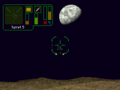
As a "cyberneer" working for the fictional Tyron Corporation, the player is tasked with installing automated defence software at the deep space mining installation MRP-6F, a large compound located around the top of a crater in which mining operations take place. Its purpose is to defend the mining installation from hostile attack. For this purpose the installation houses six powerful defence turrets installed around the crater, as well as a myriad of support systems for power generation and munitions stores for those armaments.
Shortly after the player's arrival at MRP-6F, the installation is attacked by an unknown enemy force. The player must face enemy fighters as well as invaders searching the base. The overall goal is to escape the installation with evidence of what has transpired.
Game Play
The game is reminiscent of the System Shock series in terms of gameplay. The player must explore the base to find items which is needed to establish a line of defence and ultimately escape the installation. This involves fighting off the invading enemies by deploying the defence turrets effectively and using the installation's computer terminals (called "VOS terminals") to hinder the intruder's advance.
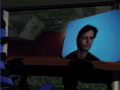
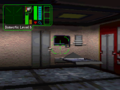
The computer terminals in the game offer an unusually wide range of interaction. Players can use them to remotely control the defence turrets, load ammunition and inspect the turrets for damage and deploy combat droids within the installation's perimeters. Doors can be controlled from the VOS terminals to control access to the installation's different areas. The player can use this capability to lock in enemy forces in parts of the installation.
The game also allows the player to fight the invaders by shooting them, but this is discouraged by the fact that new enemies arrive with each passing wave of attacking ships. Also, destroying an enemy greatly degrades the air quality in the immediate area.[5] The computer might even seal doors to polluted areas, sometimes trapping the player. The player can dissolve the pollution by opening doors to adjacent areas, and the pollution levels can be monitored in the VOS terminal's environmental module.
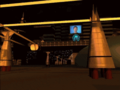
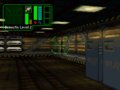
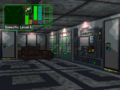
The installation consists of two major towers with seven floors each (the administrative and domestic blocks), three hangars, a service level, six turrets and a control room. All these are linked by a subway-train like transportation system named "LIMO". Several elevator systems also connect the different levels. This complex layout enables players to avoid enemies by choosing an alternate route to their destination.
Reception
Magazine Reviews
| Name | Date | Region | Rating | Notes |
|---|---|---|---|---|
| ???? | Date | Rating | Notes |
- - Need review page
Other Versions
The game was originally released for PC DOS, with later ports to the 3DO, Playstation and Saturn
Credits
- Design Chris Elliott, Ian Saunter, Andrew Kennedy, Toby Simpson
- Programming Ashley Thwaites, Peter Marshall, Dean Ashton, Tim Closs, Marcus Whitlock, Toby Simpson, Julian Rex
- Additional Programming Mark Stamps, Mike Ball, James Busby, Paul Donovan
- Art Direction Andrew Kennedy, Mark Rafter
- Introduction Modelling Rob Chapman, Steven Teague, Steve Loughran, Dave Mee
- Introduction Animation Rob Chapman
- Image Processing Steve Loughran
- Game Graphics Steven Teague, Dave Mee
- Additional Graphics Steve Loughran, Alan Brand
- 3D Design Andrew Kennedy, Mark Whitrow
- Background Text and Tyron Documents Ben Simpson
- Text and Script Editor Jim Hawkins
- Casting Chris Homer
- Casting Agency Rhubarb
- Make-up Natalie Hughes
- Costumes Angels & Bermans
- Cast Jack Cloake, Gia Milinovich, Martin Muncaster, Michael Harbour, Billy J. Mitchell, Gary Hope, Mike O'Malley, Elizabeth Uter
- Title Music Chris Homer
- Game Music Andrew Barnabas
- Audio and Video Production Chris Homer, Pete Murphy, Tom Oswald
- Sound Effects Graeme King, Andrew Barnabas, Pete Murphy
- Audio Post Production Pete Murphy
- Quality Assurance Manager Richard Edwards
- Lead Quality Assurance Tester Ben Simpson
- Quality Assurance Tom Oswald, Stuart Saunders, Jim Archer, Dean Miller, Craig Sullivan
- Producer Toby Simpson
Japanese version additions:
- 3DO Extrication Tameem Antoniades
- Published and Distributed by Multisoft Co., Ltd.
- Exclusive Licensee Multisoft Co., Ltd.
- Project Coordinated by ikenosatisfaction inc
- Producer (JP) Tohru Ikeno
- Product Coordinator Osamu Sugano
- Digital Art Director Nau Ikeno
- Designer (JP) Norikazu Haraguchi
- Audio Production Tohokushinsya Film Corporation
- Voice Talent Tomoko Shiota, Kikuko Inoue, Minami Takayama, Tamio Ohki, Kinri Arimoto
Disc Archaeology
Findings from a byte-level analysis of the Japanese retail disc image (472,170,496 bytes / 230,400 blocks).
"3DO Extrication" — an early Tameem Antoniades credit
The Japanese build's credits insert one entry absent from the European roll: "3DO Extrication — Tameem Antoniades". The joke job title ("extrication" — presumably for wrestling the port out the door) credits a young Millennium programmer who would go on to co-found Ninja Theory and direct Heavenly Sword, Enslaved and Hellblade. An obscure Japanese 3DO pressing preserves one of the earliest credits of his career, under a title he presumably chose himself.
A prestige dub, graphically subtitled
The localization credits (also in the executable) list a remarkable voice cast for a niche port: Kikuko Inoue and Minami Takayama (the voice of Detective Conan) among five credited performers, with audio production by Tohokushinsya Film Corporation and the project coordinated by a company credited as "ikenosatisfaction inc". The dub replaces the European disc's 77 numbered speech files with 100 per-level recordings (SPCH_L1–SPCH_L11+). On-screen Japanese, meanwhile, is entirely pre-rendered graphics — /data/SUBS subtitle CELs and japhud.cels HUD art; a full-image sweep finds no Japanese text anywhere on the disc.
The localization left its scaffolding behind
title.u16.oldandMultiSoft.u16.oldsit beside the shippingtitle.u16andMultiSoft.u16— superseded revisions of the new title screen and publisher logo (same sizes, different content), pressed to retail.BM_MAPold.BINandBM_DOORSold.BIN— earlier versions of game data files kept alongside their replacements.
Filesystem notes
The redundant copies of /System/Devices, Drivers, Folios, Programs, Scripts and rom_tags disagree between generations — the common multi-pass mastering artifact; the root copies verify hash-identical. The volume label is lowercase cd-rom.
Unallocated space
85,063 blocks (~166 MB, 37% of the disc) belong to no file. Every byte was checked: 100% standard iamaduck mastering filler, nothing hidden inside.
Regional Comparison
The 1995 European release (published by GoldStar) and the 1996 Japanese release (published by Multisoft) share the same Millennium Interactive game data — same graphics archives, levels and streams — with the Japanese disc carrying a substantial localization on top:
- A full Japanese voice dub: the European disc's
/vos_speechdirectory holds 77 numbered speech files; the Japanese disc replaces them with 100 per-level files (SPCH_L1–SPCH_L11+) — re-recorded Japanese dialogue, performed by a notable cast credited on the disc (including Kikuko Inoue and Minami Takayama). - Graphic subtitles, no Japanese text: the Japanese disc adds
/data/SUBS(pre-rendered subtitle CELs) and Japanese HUD art (japhud.cels,japhud_ext.cels). A full-image Shift-JIS sweep finds no Japanese text anywhere — the localization is entirely graphical and audio. - Backups of the replaced screens shipped along: the Japanese disc carries its new title screen and publisher logo plus their superseded revisions —
title.u16besidetitle.u16.oldandMultiSoft.u16besideMultiSoft.u16.old(same sizes, different content: genuine revision pairs) — and renamed data files left their predecessors behind (BM_MAPold.BIN,BM_DOORSold.BIN). - The credits diverge tellingly: the Japanese build's trademark line adds "licensed to Multisoft", appends a Multisoft/localization staff block, and inserts one credit absent from the European roll — "3DO Extrication: Tameem Antoniades" (see the JP page's Disc Archaeology).
- Both discs share a lowercase
cd-romvolume label, root-directory copies scattered across the disc rather than clustered, ~170 MB of verified-cleaniamaduckpadding (about 37% of each disc), and the era's usual stale system-directory copies.
Linked Titles
Media
-
Screenshot
-
Screenshot
-
Screenshot
-

Screenshot
-
Screenshot
-
Screenshot
-
Screenshot
-
Screenshot
-
Screenshot
-
Screenshot
-
Screenshot
-
Screenshot
-
Screenshot